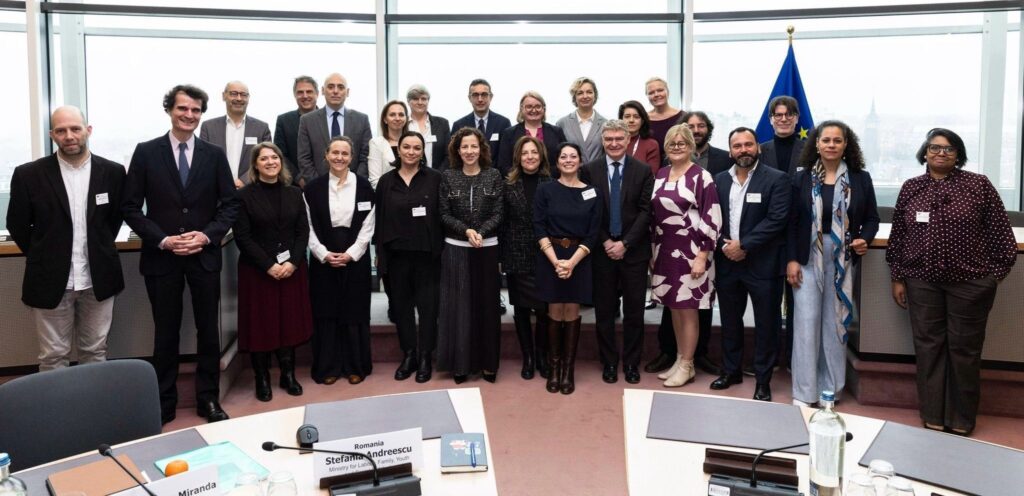
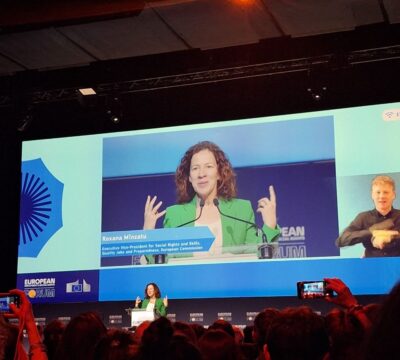
On 24 February 2026, FEBA took part in the European Commission’s “Implementation dialogue on measures to combat poverty” in Brussels. FEBA was represented by the CEO, Esteban Arriaga, accompanied by the Senior Policy & Advocacy Manager, Ignazio Corrao. The meeting brought together a limited number of key stakeholders (from member states, industry, and civil society) alongside Executive Vice-President Roxana Mînzatu and Director-General Mario Nava, creating a high-level exchange on the challenges, gaps, and developments in the implementation of minimum income schemes and the European Child Guarantee.
In his speech, Esteban Arriaga emphasised three key messages:
1) Securing an Adequate Minimum Income alone is not enough to foster social inclusion
FEBA emphasises that minimum income alone is not enough: Adequate access to essential goods needs to be secured for all. Across Europe, millions of people live in severe material deprivation. In this context, food banks, together with many partner organisations, support more than 12 million people in the EU.
2) Guaranteed access to food is the first condition for the children’s well-being
Regarding the implementation of the European Child Guarantee, FEBA sees access to nutritious food is the first condition for health, education, and equal opportunities for the children of Europe. Food banks are supporting this already with their daily operations.
3) Investing in the already existing support system for the most vulnerable is necessary for efficient implementation
Effective implementation must build on organisations that already reach the most vulnerable and help translate social rights into concrete support. To achieve the targets of the Minimum Income Schemes and the European Child Guarantee, FEBA sees the necessity of securing adequate funding, strengthening the collaboration between public authorities, civil society, and partners, and achieving a shared understanding of the implementation and coordination practices.
For FEBA, the invitation to contribute to this dialogue represents an important recognition of the network’s operational expertise and policy engagement. It also comes at a significant political moment, following the European Parliament’s formal acknowledgement – in its report on the Anti-Poverty Strategy – of the role of food banks in combating poverty and of access to nutritious food as a fundamental right.
Related articles:
Read FEBA’s take on the Report on Development of the New EU Anti-Poverty Strategy.