How can a city ensure that more surplus food is rescued and reaches the people and organisations that can use it most effectively? And how can food banks, other food rescue initiatives, logistics providers, civil society and municipalities work together rather than develop parallel solutions?
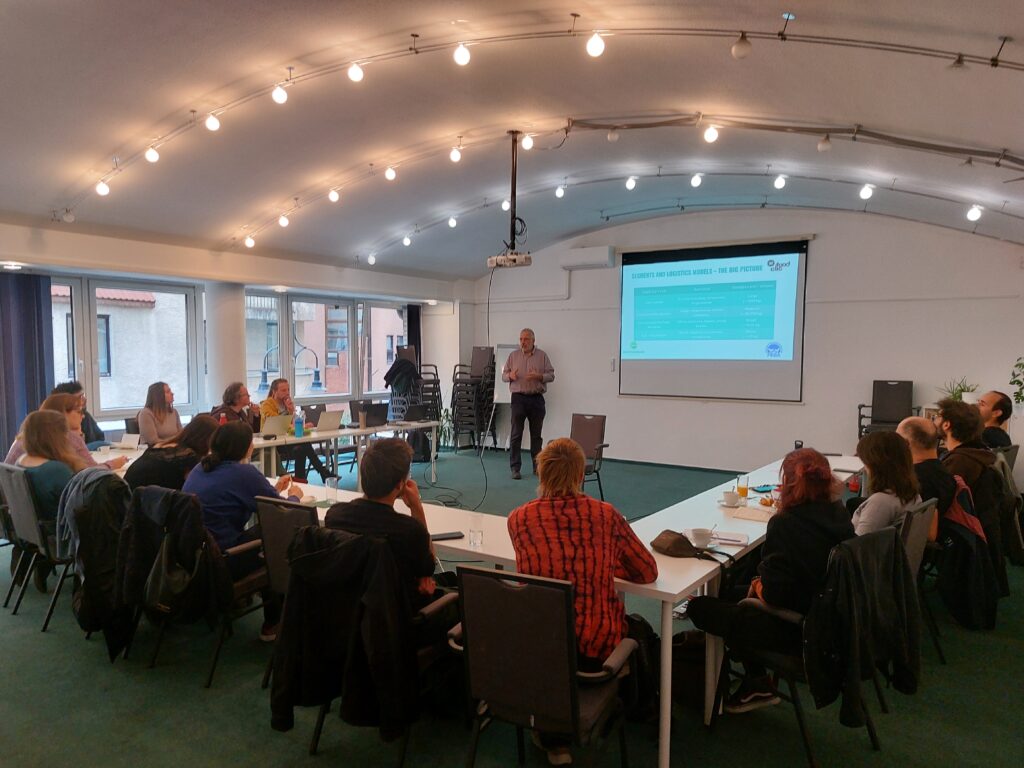
These were some of the questions at the centre of a recent workshop in Budapest, organised by the Magyar Élelmiszerbank Egyesület with the support of FEBA and the FoodCLIC project funded by the European Union. The workshop, bringing together organisations involved in food rescue and logistics, professional and research actors, and representatives of the Municipality of Budapest, explored how urban food surplus redistribution could become more coordinated, efficient and collaborative.
The starting point was simple: Budapest already has several food surplus redistribution actors, but they do not always have enough visibility of each other’s activities. In practice, this means that several organisations approach the same potential donor, while other sources of surplus remain untapped; transport capacity may be available in one network but missing in another; and receiving organisations may have very different needs and capacities at different times.
Building on What Already Exists Without Duplicating Efforts
The workshop focused on connecting which systems already exist in Budapest. Participants shared their different approaches to food rescue, including centralised and delegated distribution, volunteer and professional courier models, digital matching tools, direct redistribution to people in need, as well as solutions for processing surplus food that cannot immediately be redistributed.
The discussion highlighted the most important principles: greater transparency, information-sharing and complementarity. If organisations know who is already working with a donor, what transport capacity is available, and which receiving points can currently accept food, they can support each other instead of duplicating efforts.
Several practical next steps emerged, including a shared communication and contact network, better exchange of information on donor relationships, expanding the mapping of receiving charitable organisations, and exploring how different logistics systems could act as back-up for one another. Participants also discussed the value of keeping solutions simple at the beginning: before building new digital infrastructure, much can already be achieved through better communication and by making existing networks more visible to each other.
Connecting Food Banks and Municipalities in Urban Food Systems
The discussion also underlined the important role of municipalities in urban food systems. Cities can be much more than observers: they can convene stakeholders, connect public institutions with redistribution networks, help identify surplus and receiving capacity, support communication and infrastructure, and integrate food surplus redistribution into wider urban food strategies. In Budapest, the Municipality is already connected to initiatives involving public catering, markets, social services and food rescue, creating a strong basis for deeper cooperation.
From a food bank perspective, this points to their increasingly important role in cities: not only collecting and redistributing food but also helping to build an urban redistribution ecosystem in which different actors can contribute according to their strengths. Food banks may bring large-scale redistribution capacity, established donor relationships and networks of charities; smaller initiatives may offer flexibility, local knowledge, volunteer mobilisation or specialised logistics; municipalities can provide coordination, public infrastructure and strategic support.
Joining Efforts to Rescue More Food
The takeaways from the workshop closely align with the wider ambitions of FoodCLIC: creating more resilient, inclusive and sustainable urban food systems through stronger cooperation between public authorities, civil society, food businesses and local communities.
The Budapest workshop showed that the future of urban food surplus redistribution is not about organisation doing everything. It may instead lie in better connected local ecosystems, where food banks, grassroots initiatives, logistics actors and cities see each other as partners and combine their capacities to rescue more food, reduce waste and strengthen access to food.